
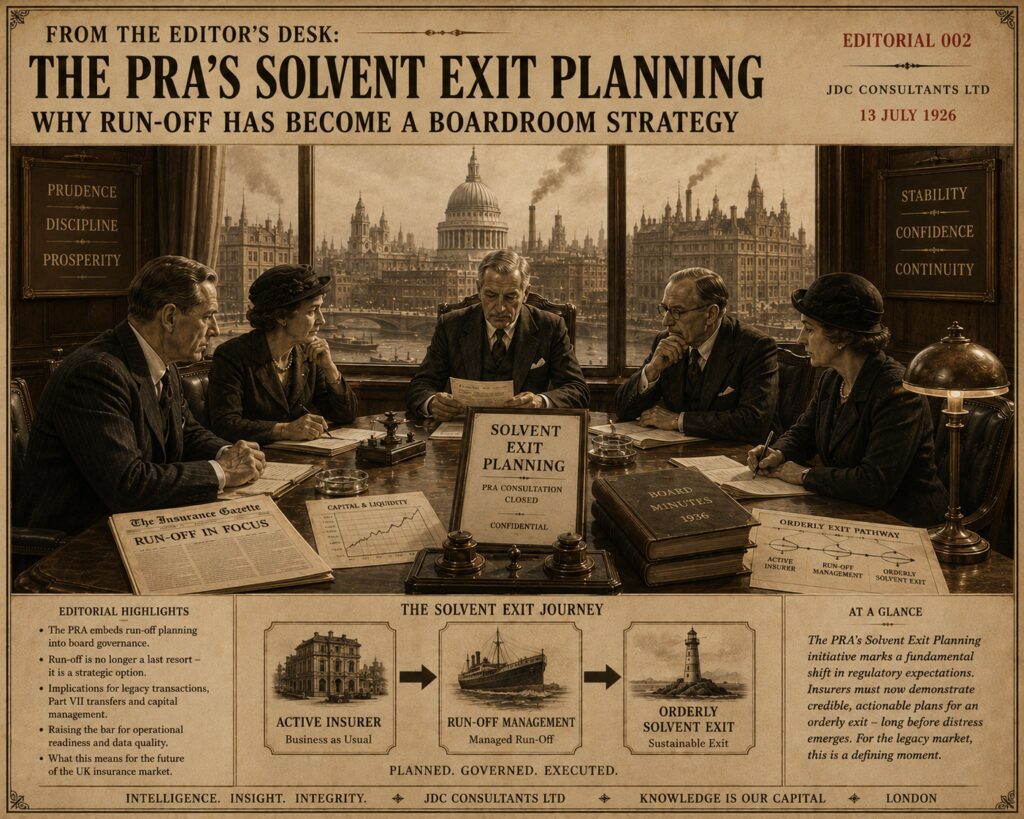
FROM THE EDITOR’S DESK
EDITORIAL: 002
DATE: July 13, 2026
SUBJECT: The PRA’s Solvent Exit Planning – How Run-Off Became a Boardroom Strategy
- A Fundamental Change in Regulatory Thinking
For many years, solvent run-off has been regarded by much of the insurance market as an operational contingency—a process to be considered only when an insurer decided to withdraw from a class of business or cease underwriting altogether. The Prudential Regulation Authority’s Solvent Exit Planning initiative fundamentally changes that perception.
Rather than asking insurers to prepare for failure, the PRA now expects firms to demonstrate that an orderly market exit forms part of normal strategic planning. Solvent exit is no longer viewed as a last resort but as a legitimate board-level consideration, supported by governance, operational readiness and credible execution plans.
In doing so, the regulator has subtly but significantly redefined the responsibilities of boards operating within the UK insurance market.
- Governance Moves to the Centre of the Legacy Market
Historically, legacy management has often been viewed through a transactional lens—portfolio transfers, Part VII schemes, loss portfolio transfers and specialist run-off vehicles.
The PRA’s latest initiative shifts the emphasis away from the mechanics of transactions and towards governance. Boards are now expected to understand how their businesses could leave the market in an orderly manner long before such a decision becomes necessary.
This represents an important evolution in regulatory philosophy. Instead of reacting to deteriorating circumstances, insurers are expected to plan proactively, ensuring that policyholders, counterparties and regulators would experience a controlled and well-governed transition should a solvent exit ever become appropriate.
The result is a more resilient insurance sector built upon preparation rather than reaction.
- Why This Matters to the Legacy Insurance Sector
Whilst the consultation is not a legacy transaction in its own right, its implications for the run-off community are considerable.
Strategic exit planning inevitably increases board awareness of:
- legacy liabilities;
- operational readiness;
- data quality;
- claims governance;
- capital efficiency; and
- the practical options available through specialist run-off providers.
As these considerations become embedded within corporate governance frameworks, boards are likely to evaluate legacy solutions earlier in the strategic planning cycle rather than waiting until balance sheet pressures force action.
For specialist legacy carriers, this represents a subtle but potentially significant change in market dynamics.
- From Contingency Planning to Strategic Optionality
Perhaps the most significant consequence of the PRA’s approach is its recognition that maintaining credible strategic options strengthens both firms and the wider insurance market.
Planning for an orderly solvent exit should not be interpreted as signalling weakness. On the contrary, organisations with robust governance frameworks, accurate operational data and clearly documented exit strategies are likely to demonstrate greater resilience and stronger overall risk management.
In many respects, the PRA has elevated solvent exit planning from an operational exercise to an integral component of enterprise risk management.
That distinction is likely to influence board agendas for many years to come.
- Looking Ahead
The PRA’s consultation marks another stage in the continuing maturation of the UK insurance market.
Future supervisory expectations are likely to place increasing emphasis upon:
- board accountability;
- operational resilience;
- governance documentation;
- high-quality data management;
- credible implementation planning; and
- the ability to execute strategic change without compromising policyholder protection.
Collectively these developments reinforce London’s position as one of the world’s most sophisticated insurance jurisdictions, combining robust prudential supervision with increasingly strategic regulatory oversight.
For the legacy sector, the message is equally clear.
Run-off is no longer simply the mechanism through which yesterday’s liabilities are resolved.
It is becoming an integral component of tomorrow’s corporate strategy.
- JDC Strategic Perspective
At JDC Consultants, we view the PRA’s Solvent Exit Planning initiative as more than a regulatory compliance exercise.
Effective exit planning depends upon the integrity of the underlying operational data, the ability to understand historical liabilities accurately, and the confidence that complex books of business can be migrated, analysed and governed without compromising regulatory expectations.
Whether supporting legacy portfolio analysis, data migration assurance, operational readiness or strategic governance, organisations that invest early in the quality and transparency of their information will be significantly better positioned to respond to future regulatory expectations.
The PRA has not merely introduced another supervisory requirement.
It has signalled that preparedness, governance and strategic optionality are now fundamental characteristics of a well-managed insurer.
For further discussion on Legacy Transaction offerings – or the contents of this Editorial – please contact: – JDC @ https://jdcconsultants.com/connect/