
EDITORIAL 001
DATE: June 15, 2026
SUBJECT: Comprehensive Granular Update on the German Legacy Insurance Direct Transaction (DARAG / Ambra)
- Operational Context & Transaction Architecture
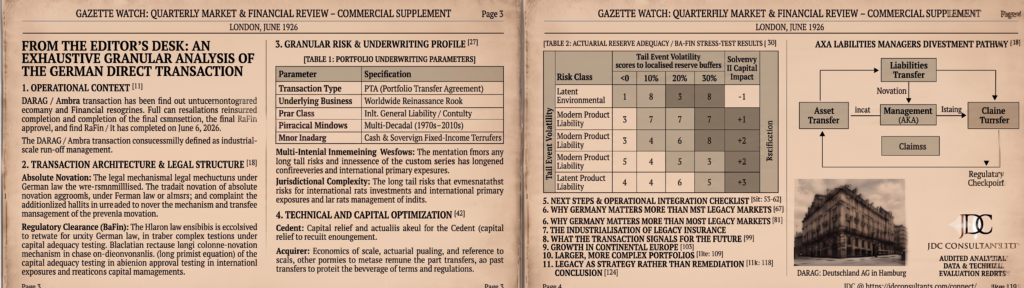
This briefing provides an exhaustive, granular analysis of the recently finalized direct transaction in Germany, executed under our monitored frameworks for European legacy risk management. The transaction involves DARAG Deutschland AG (the German insurance carrier of the DARAG Group) and Ambra Versicherung AG, an internationally operating carrier.
The execution is structured as a legally binding Portfolio Transfer Agreement (PTA) acquiring an extensive, worldwide book of discontinued reinsurance business, rather than a traditional retroactive retrocession. Following strict regulatory vetting, formal approval was granted by the German federal financial supervisory authority, BaFin, in late May 2026, with full completion and closure reached on June 8, 2026.
By systematically absorbing these legacy liabilities, DARAG assumes complete legal, economic, and operational finality for the underlying risk book (Internal Reference: EU-PIVOT-FIN). This strategic maneuver addresses two core corporate finance mandates:
- Absolute Novation: Responsibilities for claims management, reserving, and direct policyholder/cedent obligations transfer in their entirety. This clean break allows Ambra to completely eliminate operational overhead and unlock capital previously tied up as Solvency Capital Requirement (SCR) buffers under Solvency II, redeploying it into active, higher-yielding lines.
- The AXA Divestment & Scale: This specific book was structured and brought to market via AXA Liabilities Managers. DARAG was selected due to its localized German capitalization platform. The acquisition builds on top of multiple multi-million-euro portfolios executed by DARAG in early 2026 (including a €120 million Danish workers’ compensation transfer in March), achieving immediate economies of scale through their automated run-off platform.
- Granular Risk & Underwriting Profile
The acquired legacy reinsurance book possesses highly distinct parameters requiring precise operational oversight:
Parameter | Specification / Granular Metric DOCX |
Transaction Type | Portfolio Transfer Agreement (PTA) |
Underlying Business | Worldwide Reinsurance Book |
Primary Class of Risk | International General Liability / Casualty Run-off |
Underwriting Windows | Multi-Decadal (1970s through 2010s) |
Primary Asset Backing | Normalized Cash & Sovereign Fixed-Income Transfers |
- Multi-Decadal Windows (1970s–2010s): Liabilities from the 1970s–1980s are heavily weighted toward latent, long-tail commercial liability, environmental degradation, and corporate pollution, requiring specialized legacy legal defences. Risks from the 1990s–2010s transition into modern commercial casualty and product liability, exhibiting higher frequency but more predictable severity.
- Jurisdictional Complexity: Although approved by BaFin, the underlying reinsurance exposures are globally distributed across North America, the UK, and continental Europe, requiring the claims infrastructure to manage multiple legal frameworks and foreign currency fluctuations.
- Why Germany Matters More Than Most Legacy Markets
The true significance of this transaction is its location. For decades, Germany has remained a notoriously difficult market for legacy specialists to penetrate compared to the UK’s mature Part VII framework. German insurance restructuring has traditionally been constrained by:
- A fierce regulatory emphasis on absolute policyholder protection.
- Historically cautious attitudes toward external liability transfers.
- Complex interactions between insurance law, contract law, and regulatory supervision.
The success of the DARAG/Ambra transfer signals a pivotal shift. It demonstrates continued regulatory confidence in specialist run-off carriers, further normalizes portfolio transfers in Germany, and accelerates the country’s integration into the wider European legacy ecosystem.
- The Industrialization of Legacy Insurance
A decade ago, legacy transactions were viewed as exceptional, bespoke problem-solving events. Today, firms like DARAG, Enstar, Compre, Marco Capital, and RiverStone act as specialist, industrial-scale “recyclers” of insurance liabilities. Traditional insurers generate liabilities through underwriting; legacy specialists acquire, process, pool, and ultimately extinguish them over time. This evolution from cleaning up past errors to actively managing future balance sheets transforms legacy management from a remediation tool into a core corporate strategy.
- Future Market Outlook
The completion of this deal highlights three clear trends mapping the future direction of the European market:
- Continued Consolidation: Increasing transaction volumes naturally favor a small pool of scale operators capable of absorbing larger, multi-jurisdiction portfolios.
- Continental European Growth: As insurers aggressively chase capital efficiency under Solvency II, underpenetrated markets like Germany, France, Italy, and the Nordics will see surging transaction activity.
- Escalating Complexity: Future structures will routinely involve cross-border reinsurance, long-duration casualty exposures, and highly sophisticated capital optimization programs.
- JDC Operational Integration Roadmap
Were JDC entrusted with driving this integration beyond standard run-off, our execution framework would focus on four immediate checkpoints:
- Data Migration & Ledger Reconciliation: Extracting granular claims data from historical systems used by AXA Liabilities Managers and normalizing it into the target core registry platform.
- Asset Transfer Audit: Verifying that the corresponding asset portfolios backing the technical reserves are fully rebalanced into conservative, liquid, BaFin-compliant structures.
- Claims Authority Transition: Establishing explicit operational boundaries and transferring signing authorities from legacy underwriting teams to dedicated German run-off claims adjusters.
- Macro-Trend Tracking & Analytics: Extracting predictive insights from the historical data for future risk selection while monitoring how the group’s robust post-deal solvency ratios position it to absorb further European mid-market books.
For further discussion on Legacy Transaction offerings or the contents of this Editorial, please contact JDC at: https://jdcconsultants.com/connect/